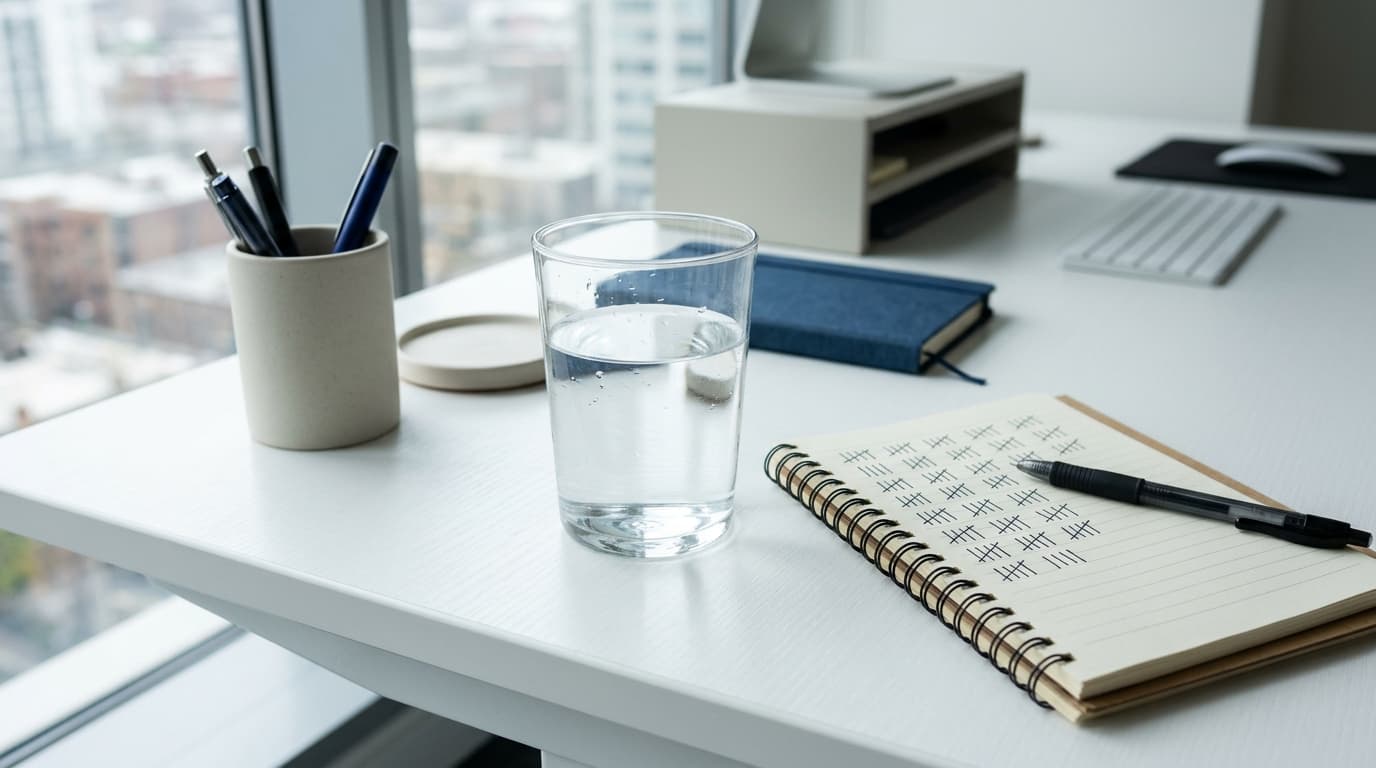
According to EFSA, an adult woman needs 2.0 litres of water a day and a man 2.5 litres. The figure is right, but it does not belong on your order form. It is total intake, food included. What an employee draws from the office water point is closer to 0.5 to 1 litre a day.
How much water do you need a day according to EFSA?
2.0 litres for women, 2.5 litres for men. That is what the European Food Safety Authority's press release of 26 March 2010 says, published with its reference values for water.
It covers all the water your body takes in. The soup, the apple and the sandwich count too. According to the European Commission's Knowledge4Policy platform, in an average diet about 80 % of daily water intake comes from water and drinks, and 20 % from food.
Do the sum and you get 1.6 litres to drink for a woman and 2.0 litres for a man.
Flemish and Dutch advice sits in the same range, and rather lower. Gezond Leven says: "Per dag drinken we best 1,5 liter water. Dat zijn 7 glazen." (Best drink 1.5 litres of water a day, which is 7 glasses.) The Voedingscentrum advises adult women to drink at least 1.4 litres and men 1.4 to 1.8 litres, all drinks combined.
From 2.5 litres to the glass at the office: four deductions
The two litres everyone knows say nothing about your office. To turn them into an order, you have to take four things off, and most quotations skip those steps.
- Food. About a fifth of total intake, according to the European Commission's figures. From 2.0 and 2.5 litres, 1.6 and 2.0 litres are left to drink.
- The hours outside work. An eight-hour working day is roughly half of your waking hours. Breakfast, dinner and the evening happen at home.
- Coffee and tea. They count as fluid. The Voedingscentrum itself advises alternating water, tea, coffee and dairy drinks, and whatever disappears into the coffee machine no longer comes out of the water cooler.
- The days nobody is there. Remote work, leave, training. An office that is full three days a week has about 13 office days a month instead of 21.
After those four steps, about 0.5 to 1 litre per person per office day is left for the water point. That is our calculation, with our assumptions. Not a standard.
You could object that half the waking hours is not half the thirst. True: someone who trains in the morning or works in a warm warehouse drinks more during the day. Someone at a desk, perhaps less. The order of magnitude does not change.
So how much water do you drink at work?
Count 0.75 litres per person per office day as a middle value, and 1 litre if you want a buffer.
What goes into the glass makes little difference to the quantity. Tap water, filtered mains water or SPA Reine from a pack: the body counts litres, not brands. The choice between the three is about taste, temperature, location and price per litre. Gezond Leven, which in its meeting tips recommends tap water over bottled water, adds straight away: "Nood aan fris water? Zorg voor watercoolers." (Need cold water? Provide water coolers.)
Mains water is no second choice either. According to the Flanders Environment Agency (VMM), 99.56 % of analyses of Flemish drinking water met the standards in 2024.
The counter-argument: better too much water than too little
The strongest objection to all this arithmetic is simple. An office that brings in too much water loses some money. An office that plans too little leaves thirsty people at their desks. So why not just count 2 litres per person?
Because the difference is not a few euros. It is almost a factor of four.
With a cooler that has no water connection, you pay per litre. The SPA Fountain compact rents for 18.50 euros a month, excluding VAT, with a three-month notice period, and works only with 10-litre SPA Reine packs. You order those packs separately. At office supplier Bruneau, a pack was listed on 21 October 2026 at 13.49 euros each and 11.95 euros each for three, excluding VAT, marked as out of stock. That is 1.20 to 1.35 euros a litre.
A mains-fed cooler from Culligan works differently: a fixed monthly price on quotation, and the water itself comes from the mains. At De Watergroep, that water costs 3.13 euros per cubic metre at the basic rate and 6.26 euros at the comfort rate in 2026, including 6 % VAT, according to CallMePower's tariff overview. Add regional and municipal sanitation and it lands between 0.5 and 1 cent a litre. With that kind of machine, a generous estimate barely matters. With packs, it shows on every invoice.
So here is the nuance. Plan generously for the first month, then count. A stack of empty packs or a meter reading on the cooler tells you more than any standard.
The assumption sets the budget
Back to the litre: the same office of ten people, five assumptions. Amounts for packs and the cooler are excluding VAT; tap water is including 6 % VAT and without the standing charge. The machine itself is not in the tap water column.
| Assumption per person per office day | Office days a month | Litres a month | 10-litre packs | SPA Fountain compact + packs, per month | Tap water, per month |
|---|---|---|---|---|---|
| 2.0 litres, the full EFSA figure at the office | 21 | 420 | 42 | 520 to 585 euros | 2.25 to 3.98 euros |
| 1.0 litre | 21 | 210 | 21 | 269 to 302 euros | 1.12 to 1.99 euros |
| 0.75 litres | 21 | 158 | 16 | 210 to 234 euros | 0.84 to 1.49 euros |
| 0.75 litres, three days a week in the office | 13 | 98 | 10 | 138 to 153 euros | 0.52 to 0.92 euros |
| 1.5 litres, warm spell | 21 | 315 | 32 | 401 to 450 euros | 1.69 to 2.99 euros |
Whoever sticks the EFSA figure on the office without deductions orders in the first row. Whoever makes the four deductions sits in the third or fourth. The gap is 42 against 10 packs, or 320 kilos of water a month that nobody has to receive and stack.
In the small print: the pack price we found applied to a product listed as out of stock, and another distributor may charge differently. Always ask for the price per pack in the quotation, with the VAT stated.
A hot day changes the sum
On a very hot day, the Voedingscentrum advises adults to drink at least 2 litres to prevent dehydration. At the office, we then count 1 to 1.5 litres per person instead of three quarters, so almost double the order in the weeks it is warm.
Legally, something is added too. Above certain heat thresholds, the employer must provide suitable refreshing drinks free of charge. How those thresholds work is in our article on drinking water at work and the employer's obligation.
One extra week of stock in June costs less than an empty cooler in July.
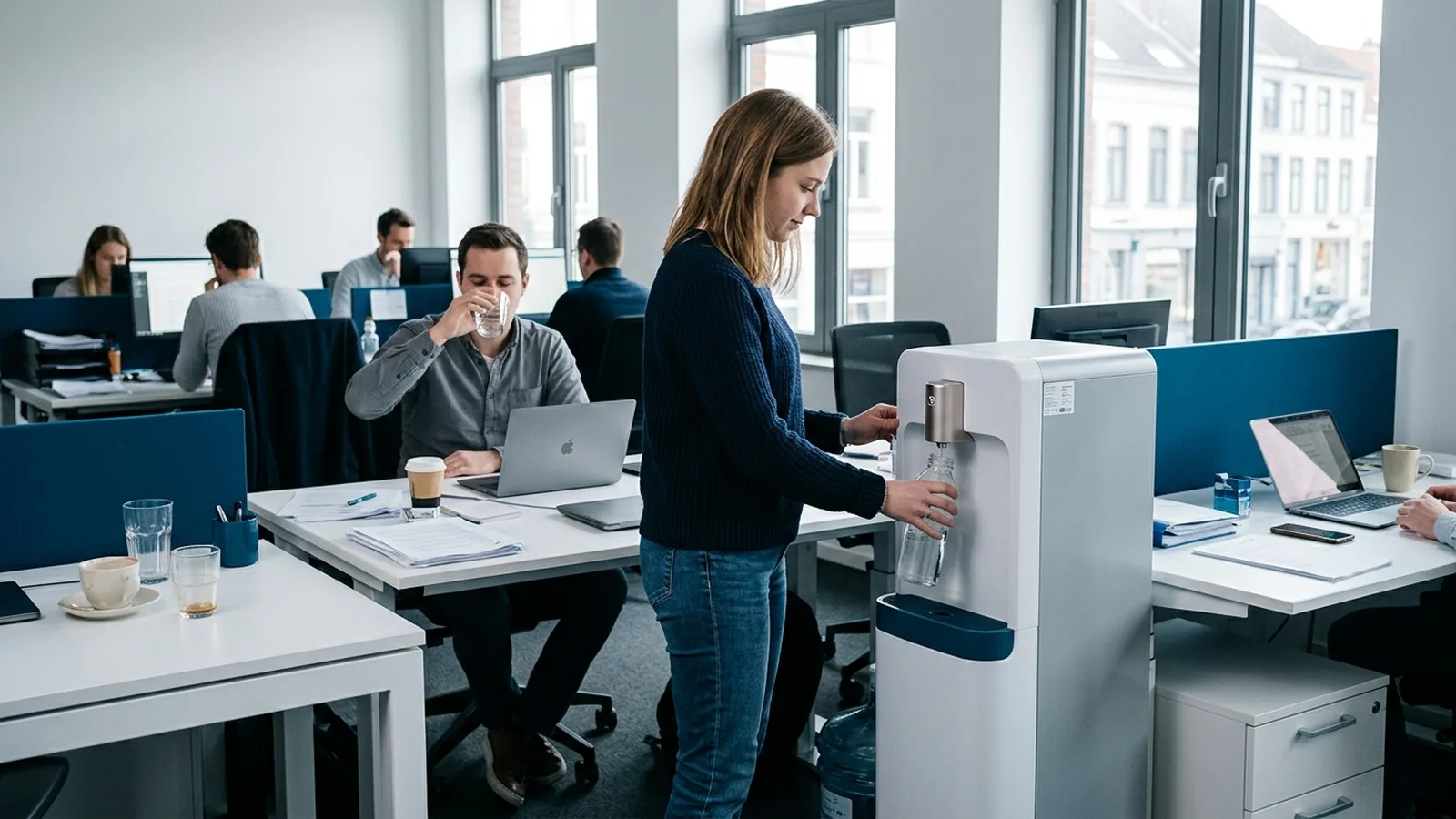
How can you tell at your desk that you are drinking too little?
The Voedingscentrum names two signals: thirst, and very dark urine. It does add that food, drinks and medication also affect urine colour.
What helps at the office to stay ahead of those signals is practical rather than medical:
- a water point on every floor, not only in the ground-floor kitchenette;
- water within reach during meetings, which Gezond Leven explicitly recommends;
- large glasses or personal bottles, because according to Gezond Leven you then drink more without thinking about it;
- cold water if that makes the difference for your team, with a mains-fed or pack-fed cooler;
- in a warm week, a second water point or an extra order.
Too much is possible as well. The Voedingscentrum advises not to drink more than 3 litres a day in heat or illness, because the sodium in the blood can otherwise drop too far. Anyone with a medical reason to drink more or less should follow their GP's advice, not an average.
What a cooler costs per month beyond the water is in water cooler rental: the price per month and per litre. The machines themselves are side by side in the ranking of office water coolers.
Sources
Consulted on 21 October 2026.
- EFSA, press release on dietary reference values for nutrients, with 2.0 litres of water a day for women and 2.5 litres for men (26 March 2010, EFSA Journal 2010;8(3):1459): efsa.europa.eu
- European Commission, Knowledge4Policy, Water (80 % of intake from water and drinks, 20 % from food, updated on 5 November 2025): knowledge-for-policy.ec.europa.eu
- Gezond Leven, Healthy meetings, tip 1: drink water (1.5 litres or 7 glasses a day, 3 to 4 cups of coffee, water coolers): gezondleven.be
- Voedingscentrum, encyclopedia entry on fluid (1.4 to 1.8 litres, thirst and urine colour, 2 litres on a very hot day, no more than 3 litres in heat or illness): voedingscentrum.nl
- Voedingscentrum, question on the daily amount of water (1.5 to 2 litres for adults): voedingscentrum.nl
- VMM, Drinking-water quality 2024 (99.56 % compliant analyses): publicaties.vlaanderen.be
- CallMePower, price per m³ at De Watergroep in 2026 (3.13 and 6.26 euros per m³ incl. 6 % VAT, sanitation, standing charge, updated on 20 May 2026): callmepower.be
- SPA Fountain compact (18.50 euros a month, purchase 490 euros, excluding VAT, 3-month notice period, 10-litre SPA Reine packs only): spafountain.be
- Bruneau, 10-litre SPA Reine pack, ref. 793-286 (13.49 euros each, 11.95 euros each for three, excl. VAT, out of stock): bruneau.be
- Bruneau, Spadel mineral water range: bruneau.be
- Culligan, water fountains for businesses (mains-fed coolers, price on quotation): culligan.be
- Our own calculation. Drinking: 2.0 and 2.5 litres minus 20 % from food = 1.6 and 2.0 litres. At work: half of waking hours, minus coffee and tea, gives 0.5 to 1 litre at the water point. Table: 10 people; 21 office days a month, or 13 at three days a week; packs rounded up; packs at 11.95 to 13.49 euros plus 18.50 euros rental, excl. VAT; tap water at 5.35 to 9.48 euros per m³ incl. VAT (3.13 or 6.26 euros drinking water + 1.42 euros regional sanitation + 0.80 to 1.80 euros municipal sanitation), without standing charge; 1 litre of water weighs 1 kilo.
Comparator
Compare water coolers side by side.
Compare now →
Frequently asked questions
The Beste Waterkoeler editorial team compares office water coolers and drinking water using public sources: product pages, price lists, technical sheets and official figures. The articles are written with AI and reviewed by the editorial team. Every price and figure is shown with its source and the date we read it. We do not test the machines ourselves.