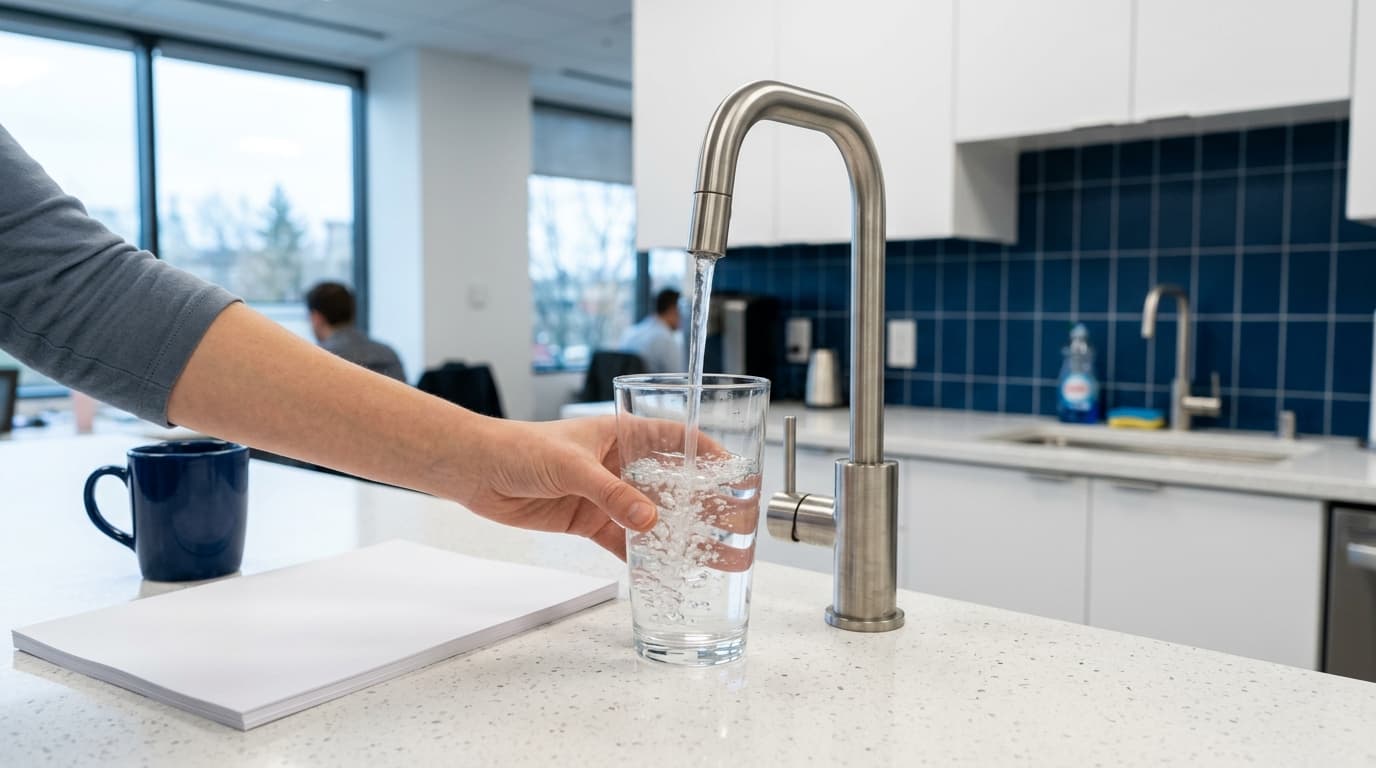
Yes. An employer in Belgium must make drinking water or another drink available to employees. That is Article III.1-63 of the Code on Well-being at Work (Codex welzijn op het werk). Tap water is enough, the water points must be easy to reach, and in heat above the WBGT action values free refreshing drinks come on top.
Is drinking water at work mandatory in Belgium?
Yes, with no exemption for small firms. The FPS Employment sums up the rule like this: depending on the nature of the work and the nature of the risks, the employer makes drinking water or another drink available. The distribution points are easy to reach and individual cups are provided, single-use if need be.
Three requirements, then, and none of them is about a machine:
- there is drinking water or another drink;
- the water point is close enough to the workstation for people to actually go there;
- everyone drinks from their own cup or glass.
You decide where that facility goes and how it is equipped after advice from the occupational physician and the committee for prevention and protection at work.
Is tap water enough, or does it have to be mineral water?
Tap water is enough. The Code asks for drinking water and says nothing about the source.
There is no reason to doubt that tap water either. According to the Flanders Environment Agency (VMM) figures for 2024, 99.56 % of analyses met the standards. The exception is a place where purity cannot be guaranteed, for instance during pipe works or in an old warehouse with a tap nobody has used for months. Then something else is needed: bottles, packs or a cooler.
So mineral water is a choice. A reasonable one, if your team will not drink the water from the kitchenette or the tap is at the wrong end of the building. But not a duty.
How much water should you plan per employee?
The law gives no litres. It says "drinking water available", and stops there.
So we do the sums ourselves. EFSA recommends, according to the summary on Wikipedia, a total water intake of 2.0 litres a day for women and 2.5 litres for men, food included. Part of that is drunk at home, part of it is coffee. For the office water point we take one litre per person per working day as a working assumption, and a litre and a half in warm weather. Those are our assumptions, not a standard.
Back to the litre, with our own calculation: ten people, one litre, 21 working days a month. That is 210 litres a month. From the tap, it is 0.21 cubic metres on your water bill, an amount you will not find in the accounts. From a cooler running on 10-litre packs, it is 21 packs, so 210 kilos of water that someone has to receive, stack and connect. At a litre and a half, it is 315 litres, or 32 packs if you round up. Do that sum before you sign a rental contract for a machine.
When do you have to hand out free drinks in hot weather?
As soon as the WBGT index exceeds the action value for the type of work. Book V, Title 1 of the Code covers this, and the FPS Employment guidance gives the four thresholds.
| Situation | Threshold | What you must provide |
|---|---|---|
| Ordinary working day, any company | None | Drinking water or another drink, a reachable water point, individual cups |
| Light or very light work (office, secretarial) | WBGT 29 | Free suitable refreshing drinks |
| Moderate work (standing work) | WBGT 26 | Free suitable refreshing drinks |
| Heavy work (digging, hand sawing) | WBGT 22 | Free suitable refreshing drinks |
| Very heavy work (earthworks) | WBGT 18 | Free suitable refreshing drinks |
| Dirty work, risk of intoxication or contamination | On the occupational physician's proposal | Drinking fountains or water points with disposable cups |
| Temporary or mobile construction site | Royal Decree of 25 January 2001, according to BeSWIC | Enough drinking water near the workstation, possibly another non-alcoholic drink |
| Cold workplace | Below 5 °C, according to ORBISS | Hot drinks such as soup, coffee or tea |
In the small print: the WBGT index is not an ordinary temperature. It is measured with a wet bulb globe thermometer that also takes humidity and radiation into account, and the result often comes out lower than what the thermometer on the wall shows. An office at 30 degrees is therefore not automatically above 29. The occupational physician is the one who assesses the workload.
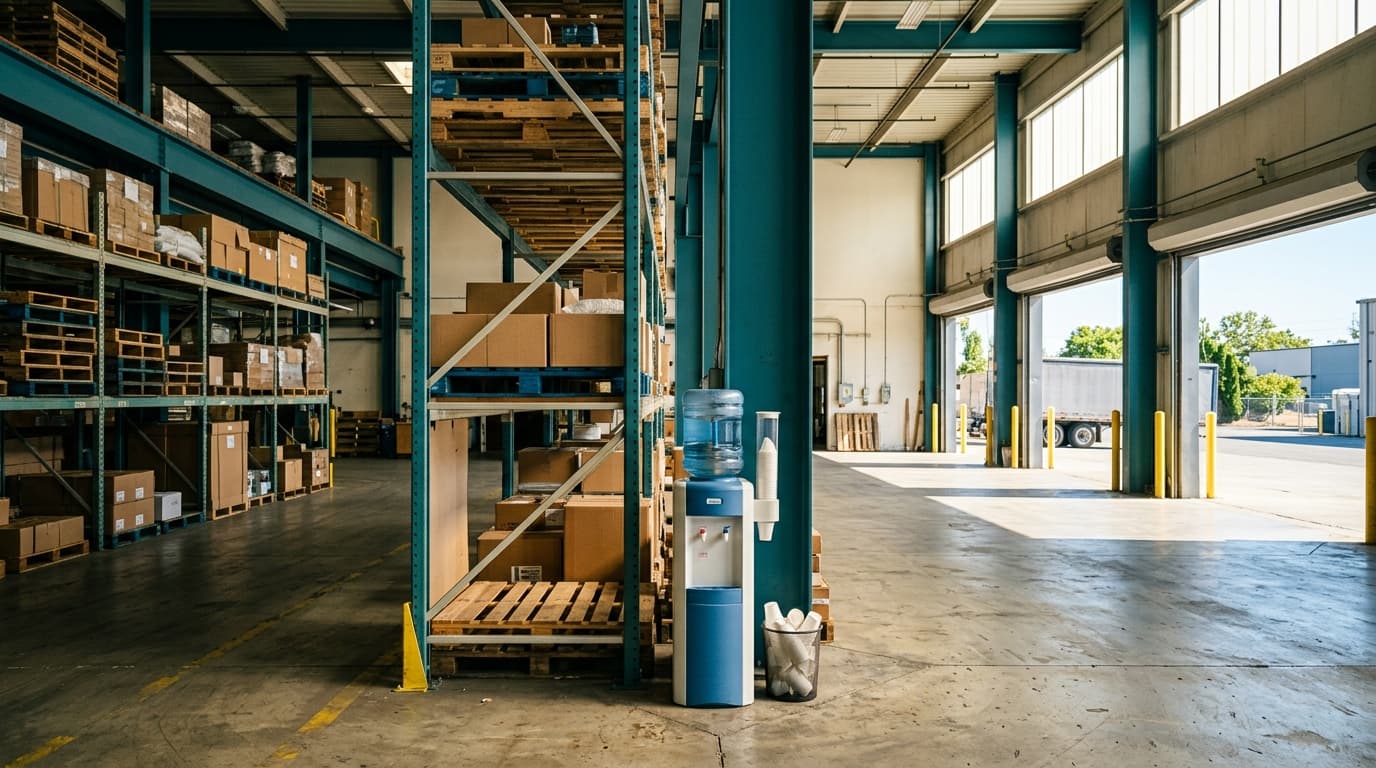
When the value is exceeded, drinks are not the whole story. The employer also provides protection against direct sun and installs a ventilation system in the work premises within 48 hours. If the discomfort persists, rest periods follow.
Do you need a water cooler, or will the tap do?
The tap will do, if it is within reach and there are cups next to it. A water cooler solves a different problem: distance, taste or temperature.
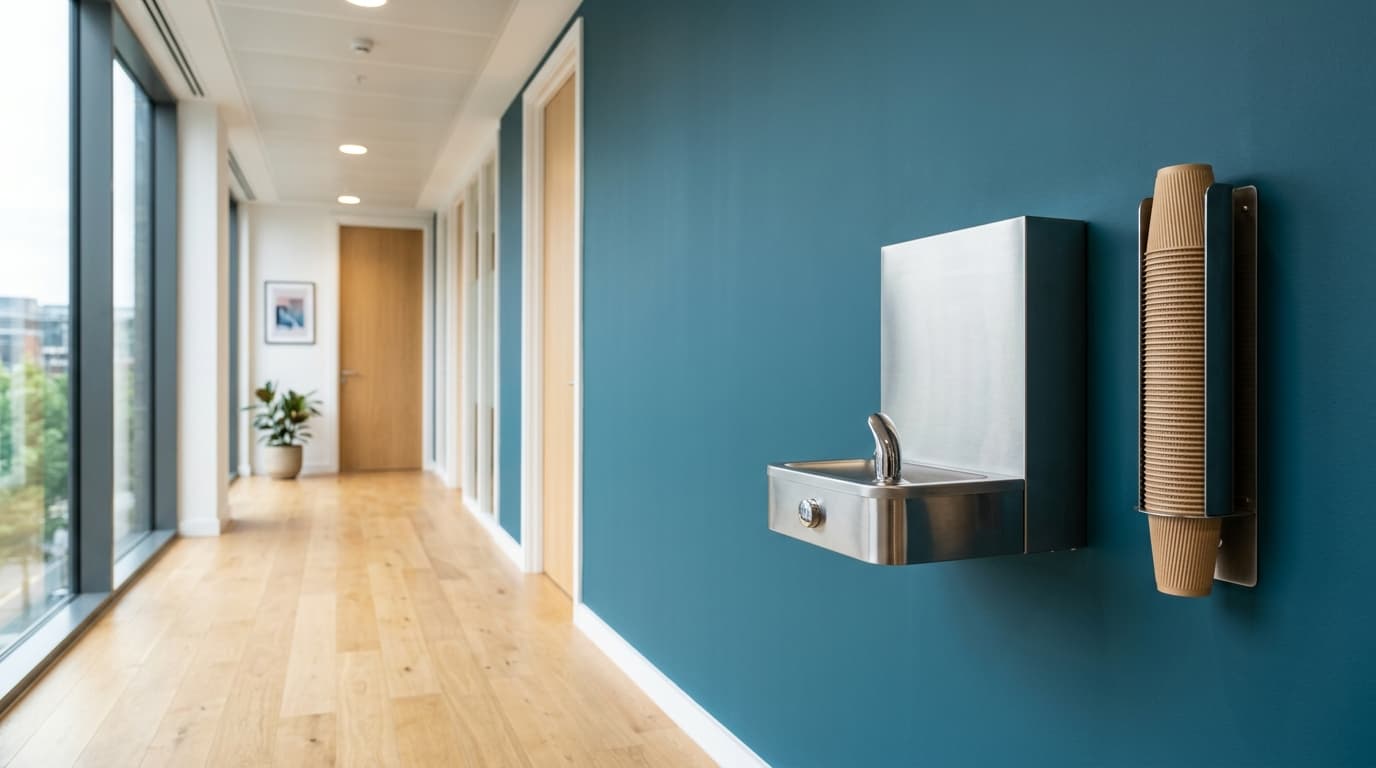
If you do go for a machine, there are two families. A mains-fed cooler from, say, Culligan or BRITA (the VIVREAU Top) filters and chills your tap water, needs a water connection and is usually rented on quotation for several years. The second family works without a water connection, on bottles or packs. The SPA Fountain, for example, dispenses SPA Reine, a natural mineral water, from 10-litre packs. The rental is 18.50 euros a month for the countertop model and 20 euros for the freestanding one (prices from spafountain.be, consulted on 1 October 2026, VAT status not stated), with no long-term contract and no plumber. The limits: still water only, the packs are ordered and paid for separately, and you need storage space.
So the water in the glass differs. The legal duty is met with either, and with neither. The per-litre sums are in mains-fed water cooler or packs, and you can compare the machines in the ranking of office water coolers or the comparison tool.
A personal bottle for each employee, such as a Dopper, settles the cup question without disposable plastic. It does not replace the water point.
Who checks, and who can you turn to?
First the prevention adviser of your internal or external service. Then the regional directorate of the Supervision of Well-being at Work. There are no further steps.
A five-minute check for an office manager
Walk through the building once with this list. A warehouse or outbuilding far from the nearest drinking-water tap often only shows up when someone goes and looks.
- Is there a point with drinkable water on every floor and in every outbuilding?
- Are there cups or glasses, or does everyone have their own bottle?
- Do you know who the occupational physician is and when the water point was last discussed?
- Does your heat plan say who orders the drinks when the WBGT threshold is exceeded?
- Have you ever counted monthly consumption, in litres?
Sources
Consulted on 4 October 2026 (SPA Fountain prices on 1 October 2026).
- FPS Employment, refectories, drinks and rest rooms: werk.belgie.be
- FPS Employment, employees' rights in hot weather (WBGT action values, measures when exceeded): werk.belgie.be
- Code on Well-being at Work, Book III, Title 1 (Article III.1-63): werk.belgie.be, pdf
- BeSWIC, heat and access to drinking water, including the Royal Decree of 25 January 2001 on construction sites: beswic.be
- Prevent, workplaces in the legislation: prevent.be
- ORBISS, drinks at work, hot drinks below 5 °C and tax treatment: orbiss.be
- VMM, drinking-water quality 2024 (99.56 % compliant analyses): publicaties.vlaanderen.be
- EFSA, water intake (EFSA Journal 2010;8(3):1459), summarised on Wikipedia
- Culligan, mains-fed water fountains for businesses: culligan.be
- SPA Fountain, FAQ and rental prices (18.50 and 20 euros a month, 10-litre packs): spafountain.be
- Our own calculation: 210 litres, 21 packs, 0.21 m³ and 210 kilos a month, and 315 litres or 32 packs at a litre and a half. Assumptions: 10 people, 1 or 1.5 litres per person per working day, 21 working days a month, 1 litre of water weighs 1 kilo.
Comparator
Compare water coolers side by side.
Compare now →
Frequently asked questions
The Beste Waterkoeler editorial team compares office water coolers and drinking water using public sources: product pages, price lists, technical sheets and official figures. The articles are written with AI and reviewed by the editorial team. Every price and figure is shown with its source and the date we read it. We do not test the machines ourselves.