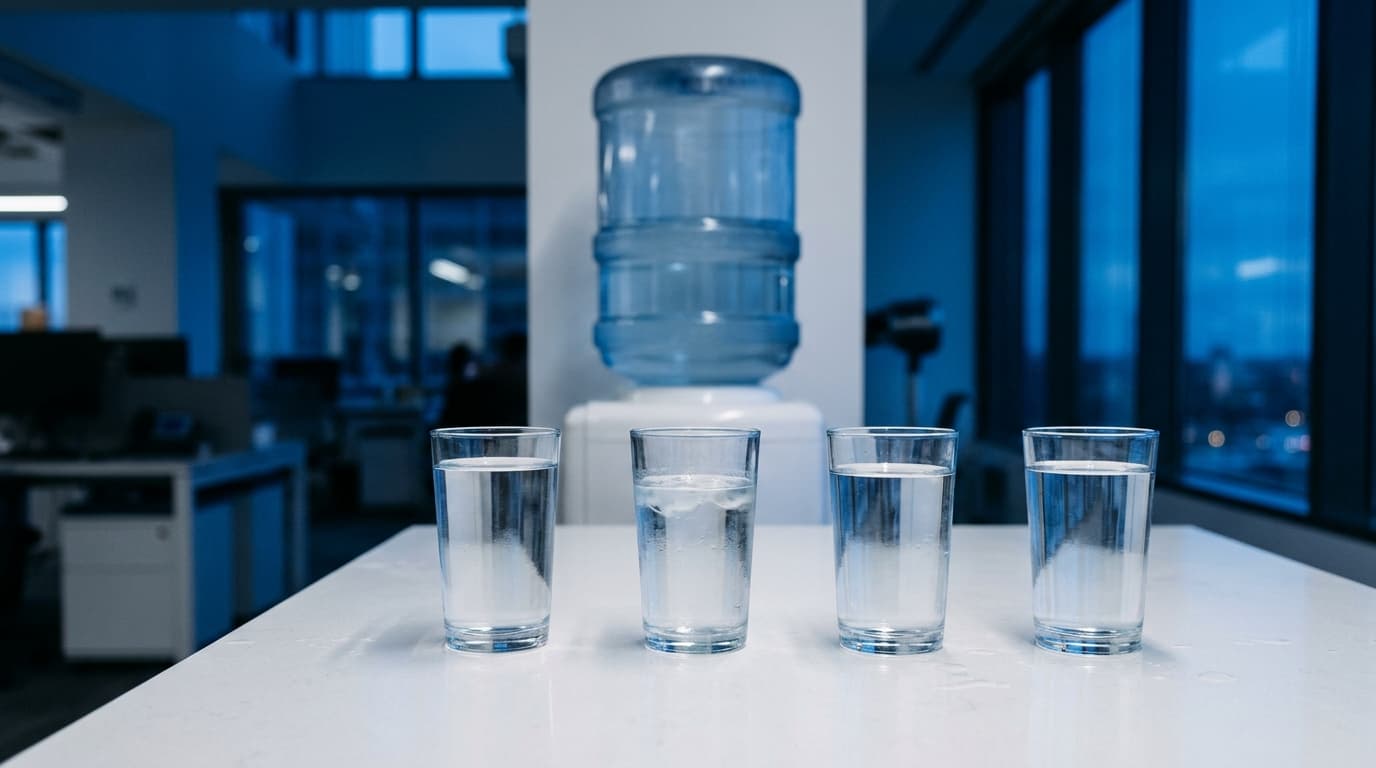
Natural mineral water and spring water both come out of the ground and are bottled at the source. The difference fits in three words: recognition, stable composition and original purity. Mineral water needs all three. Spring water does not. At the office, that distinction decides whether you pour from a bottle, a pack or the mains, and what you pay per litre.
What is the difference between spring water and mineral water?
Mineral water has a fixed composition and an official recognition. Spring water must be drinkable as it comes out of the ground, but its composition may vary.
That is how Belgian consumer organisation Test-Aankoop sums it up in its water test of 17 July 2025. Both come "from a protected underground aquifer". Natural mineral water has "a stable composition of minerals and trace elements, regardless of the flow rate". Spring water "must be drinkable in its natural state", and its mineral composition "may fluctuate slightly".
Test-Aankoop adds a point that is often forgotten: this does not mean one water is richer in minerals than the other.
What exactly is natural mineral water?
A water with a licence. In Belgium the Royal Decree of 8 February 1999 governs it, transposing European Directive 2009/54/EC.
The definition, as quoted by the Belgian Federal Public Service Health: microbiologically wholesome water from an underground aquifer, clearly distinguished from ordinary drinking water by its natural composition and its original purity. Water that does not meet that definition may not be sold as natural mineral water. If a substance of human origin is measured above the limit of quantification, there is no recognition, or it is withdrawn.
What ends up in the glass: SPA Reine is such a water. It comes from the Hoge Venen (High Fens), spends 2 to 3 years underground according to Spadel, and contains 38 mg of dry residue and 3 mg of sodium per litre.
What is spring water?
Also groundwater, also bottled at the source, but without recognition as a mineral water. Article 9 of Directive 2009/54/EC reserves the term spring water for water bottled at the source in its natural state, and also refers to the European drinking water standards.
Two differences show up in practice. The composition does not have to be constant. And the analysis does not have to be on the label: the directive requires that statement for natural mineral water, but does not carry it over into the rules for spring water.
Can spring or mineral water be treated?
Hardly, and that goes for both. Article 4 of the directive lists what is allowed: separating unstable elements such as iron, manganese and sulphur, possibly with ozone-enriched air, and removing or adding carbon dioxide. Any disinfection is prohibited. Spadel puts it this way for SPA Reine: the water "undergoes no chemical or microbiological treatment".
That ban does not apply to tap water: the directive only covers packaged mineral and spring water.
And tap water, or filtered water from a water cooler?
Tap water is neither spring nor mineral water, even when it comes from an aquifer and even when a cooler filters it. It is good drinking water, though. According to the Flanders Environment Agency (VMM), 99.56% of the analyses of Flemish drinking water were compliant in 2024.
A mains-fed cooler adds chilling and filtering. Culligan fits some models with a UVC lamp which, according to the manufacturer, removes up to 99.9999% of bacteria and viruses. The result is called filtered or purified tap water. There is no label with an analysis, but there is the report of your water utility.
What do sparkling, naturally carbonated and added carbon dioxide mean?
The directive, in its first annex, defines three kinds of sparkling natural mineral water:
- naturally carbonated: as much carbon dioxide as at the spring;
- fortified with gas from the spring: extra carbon dioxide, but from the same source;
- with added carbon dioxide: carbon dioxide of another origin.
Bru describes its bubbles as natural, picked up from carbon-bearing rock beneath the Ardennes. Sparkling water from a mains-fed cooler is a different product: tap water with carbon dioxide from a cylinder.
Bottle, pack or mains: the water per appliance
Back to the litre. The amounts cover the water only, without rental or purchase of the appliance.
| At the office | Which water | Treatment | Analysis on the label | Price per litre |
|---|---|---|---|---|
| Mains-fed cooler | Tap water, chilled and filtered | Disinfection allowed, filter or UVC in the appliance | No, but the water utility's report | 0.54 to 0.95 cent incl. VAT (De Watergroep, 2026) |
| Bottled cooler with 18-litre bottles | Usually spring water | Only what Article 4 allows, no disinfection | Not required by the directive | 0.60 to 0.90 euro (Bobex) |
| Dispenser with 10-litre packs | Natural mineral water, e.g. SPA Reine | Only what Article 4 allows, no disinfection | Required | 1.20 to 1.35 euro excl. VAT (Bruneau) |
For ten colleagues who each pour 1 litre per office day, 21 days a month, that is 210 litres. It comes to 1.12 to 1.99 euro of tap water, 126 to 189 euro of spring water in bottles, and 251 to 283 euro of SPA Reine packs. Our calculation, with those assumptions.
The small print: the tap water price is the 2026 De Watergroep tariff including sewerage charges, without the standing charge. The Bobex page carries no date. And the pack at Bruneau was marked as depleted on 23 October 2026, at 13.49 euro each and 11.95 euro per three.
How do you read the label of a bottle or a pack?
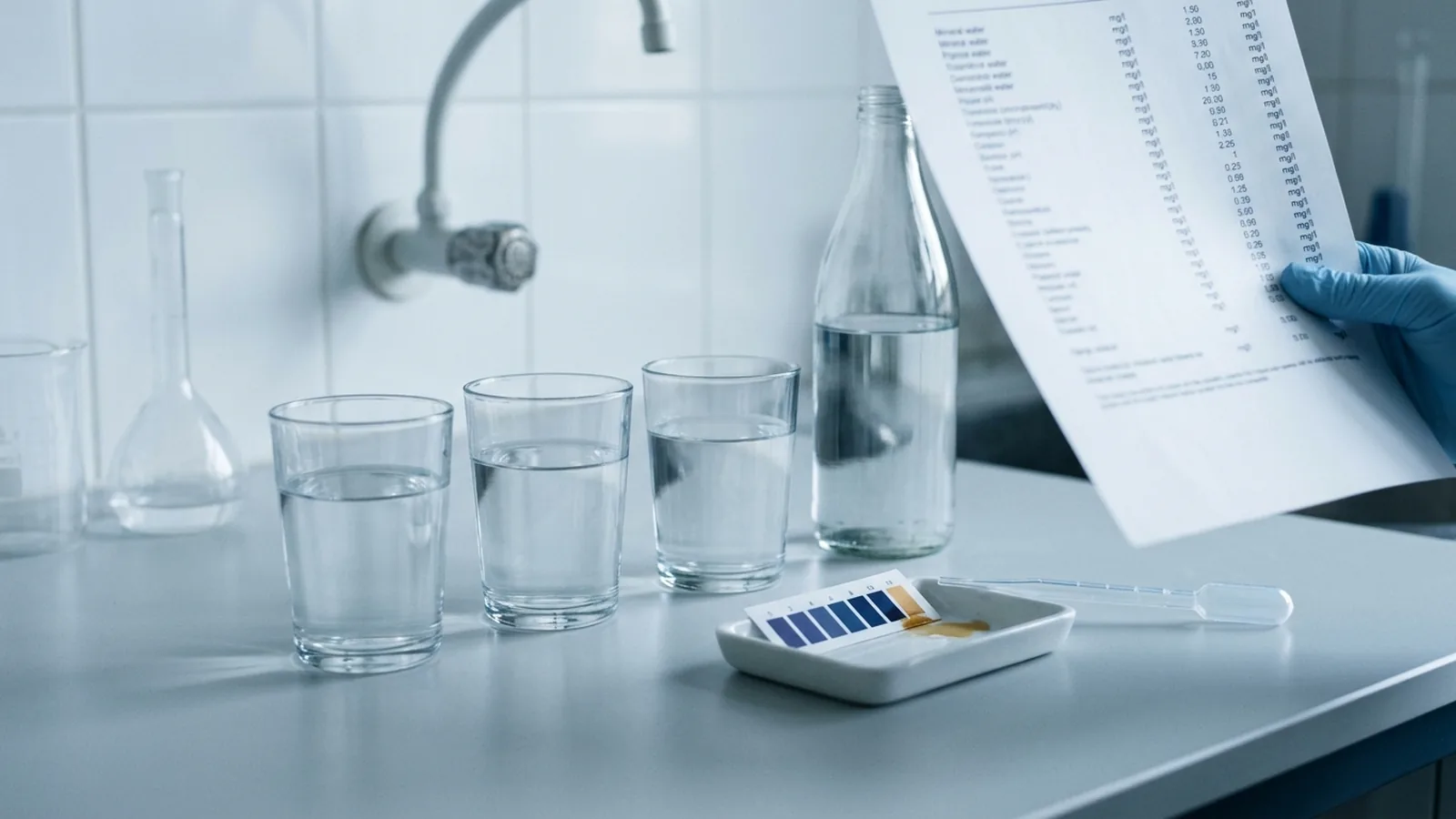
Five things say more than the picture of a mountain:
- the legal name: natural mineral water, spring water or plain drinking water;
- the name of the spring and the place where it is exploited, mandatory for mineral water;
- the dry residue in mg per litre: up to 50 very low in minerals, up to 500 low, above 1,500 rich in mineral salts;
- sodium: below 20 mg per litre the label may say "suitable for a low-sodium diet";
- a statement about ozone-enriched air, if the water was treated that way.
Those thresholds are set out in Annex III of the directive. SPA Reine, at 38 mg of dry residue, is below the 50 mark.
Is mineral water healthier than spring water or tap water?
The law does not let a producer claim that. For natural mineral water, the directive prohibits any statement attributing to the water properties for the prevention or cure of disease. And as Test-Aankoop writes, one water is not automatically richer in minerals than another.
At the office the choice is about something else: taste, a composition that is the same every week, a source that does not depend on the pipes in your building, and the price per litre. How tap water and bottled water compare on those points is covered in tap water or bottled water at the office. Which mineral waters sit side by side in Belgium is shown in the mineral water ranking. What an appliance costs per month on top of the water is in water cooler rental: the price per month and per litre.
Sources
Accessed on 23 October 2026.
- Directive 2009/54/EC on the exploitation and marketing of natural mineral waters (Article 4 treatments, Article 7 labelling, Article 9 spring water and prohibited statements, Annex I: definitions and types of sparkling water, Annex III statements and thresholds): eur-lex.europa.eu
- FPS Health, communication on the original purity criterion for natural mineral water (definition from the Royal Decree of 8 February 1999, recognition and withdrawal): health.belgium.be
- FASFC, quality of water intended for human consumption (Royal Decree of 8 February 1999 for mineral and spring water, Royal Decrees of 14 January 2002 and 4 February 2024 for packaged water, updated on 19 August 2024): fasfc.be
- Test-Aankoop, Welk merk drinkwater is het beste? (17 July 2025, difference between mineral water and spring water): test-aankoop.be
- Spadel, SPA Reine (natural mineral water, 38 mg dry residue, 3 mg sodium, 2 to 3 years underground, no chemical or microbiological treatment, 5 and 10-litre packs): spa.be
- PS in foodservice, product sheet Bru sparkling 1 litre (natural bubbles from beneath the Ardennes): psinfoodservice.com
- VMM, Drinking water quality 2024 (99.56% compliance): publicaties.vlaanderen.be
- Culligan, water fountains for businesses (mains-fed coolers, UVC up to 99.9999%, price on quotation): culligan.be
- Bobex, supplier profile Culligan Water Coolers (spring water in bottles): bobex.be
- Bobex, price of a water cooler (0.60 to 0.90 euro per litre for bottles, choice of spring or mineral water, no date): bobex.be
- Bruneau, water fountains with bottles (kit with 6 bottles of 18-litre spring water): bruneau.be
- Bruneau, SPA Reine 10-litre pack, ref. 793-286 (13.49 euro each, 11.95 euro per three, excl. VAT, depleted): bruneau.be
- CallMePower, price per m³ at De Watergroep in 2026 (3.13 and 6.26 euro per m³ incl. 6% VAT, sewerage charges, updated on 20 May 2026): callmepower.be
- Our calculation. Tap water: 5.35 to 9.48 euro per m³ incl. VAT (3.13 or 6.26 euro drinking water + 1.42 euro regional sewerage + 0.80 to 1.80 euro municipal sewerage), without standing charge. Consumption: 10 people × 1 litre × 21 office days = 210 litres per month. Packs: 21 packs at 11.95 to 13.49 euro excl. VAT. Bottles: 210 litres at 0.60 to 0.90 euro.
Comparator
Compare water coolers side by side.
Compare now →
Frequently asked questions
The Beste Waterkoeler editorial team compares office water coolers and drinking water using public sources: product pages, price lists, technical sheets and official figures. The articles are written with AI and reviewed by the editorial team. Every price and figure is shown with its source and the date we read it. We do not test the machines ourselves.