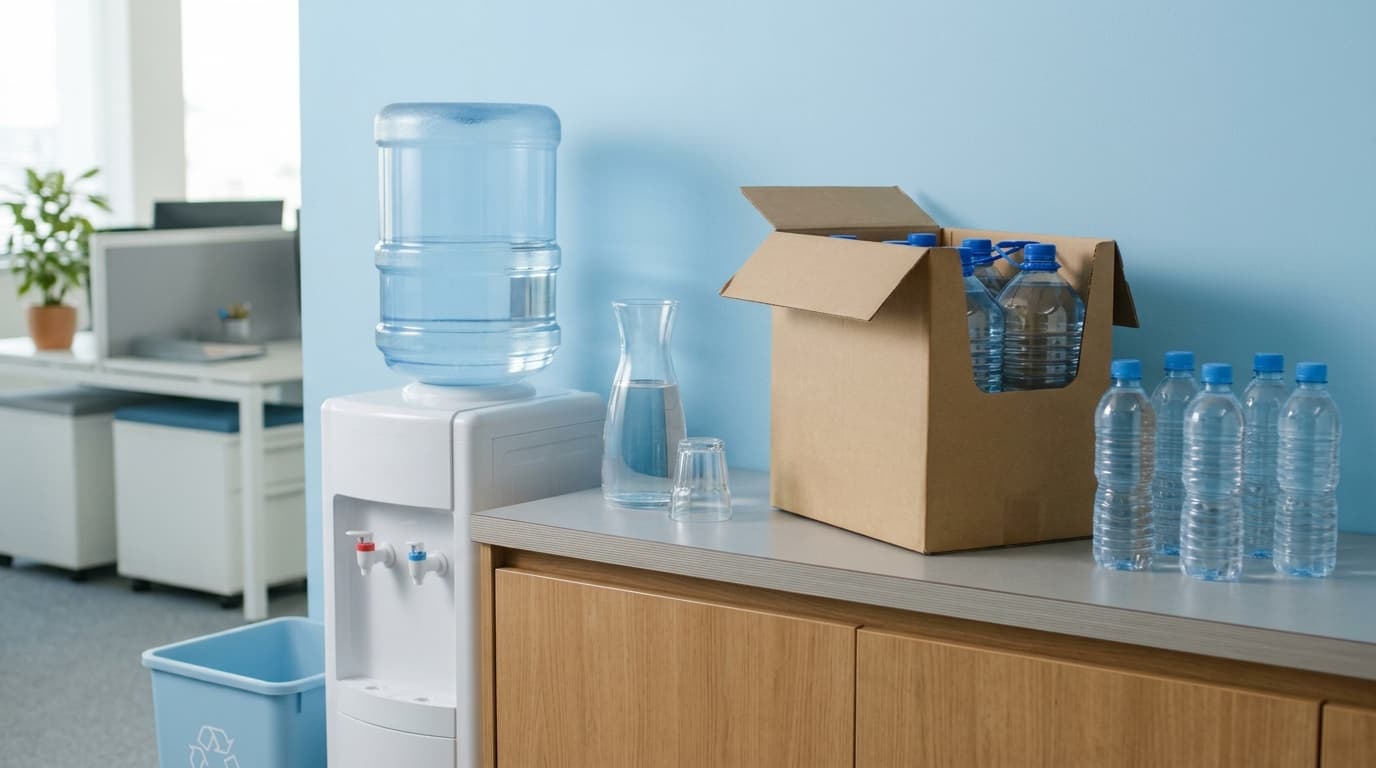
Per litre, tap water has the smallest CO2 footprint: 0.17 grams in Flanders, against 259 grams for bottled water, according to a life cycle study from Ghent University. A mains-fed water cooler mainly adds electricity, and a 10-litre pack sits between tap and bottle. For that pack, Spadel gives a percentage, not a number of grams.
How much CO2 is there in a litre of office water?
Four options, four orders of magnitude. The table puts them side by side for an office of eight people who each draw 0.75 litres per working day, 21 working days a month: 126 litres a month, 1,512 litres a year. That assumption is ours.
| Option | CO2 per litre | What the figure counts | Cost per litre (126 L a month) |
|---|---|---|---|
| Tap and carafe | 0.17 grams (Ghent University) | Tap water in Flanders, over the life cycle used in the study | 0.005 to 0.009 euro, VAT included |
| Mains-fed water cooler (BRITA, Aqualex, PHIL) | 0.17 grams of water + 6 to 7 grams of electricity (our calculation) | Water + standby consumption of the unit; no filters, no manufacturing | 0.40 to 0.53 euro at PHIL, excluding VAT |
| SPA Fountain with 10-litre SPA Reine packs | 40% less than the average of the SPA Reine PET range (Spadel); order of magnitude 155 grams (our calculation exercise) | Packaging and water according to Spadel; SPA Fountain electricity not published | 1.34 to 1.50 euro, excluding VAT |
| PET bottles | 259 grams (Ghent University) | Average bottled water in Flanders, including the bottle and transport to the shop | 0.59 euro (SPA Reine 1.5 litres, average market price, VAT not stated) |
Both Ghent University figures come from the study by Thomassen and colleagues in Science of the Total Environment (2021). We could not open the original. We use the figures as they are quoted in a comparative study in Sustainability (2023) and in the Aqualex report on the environmental impact of water. According to the first source, about 27% of the emissions of bottled water come from the PET bottle and 25% from transport to the shop.
Tap water: 0.17 grams per litre
That figure is so small that it almost disappears from the rest of the calculation. For 1,512 litres a year it comes to 0.26 kilos of CO2. What the water costs your office is on your water company's bill: at De Watergroep, 3.13 euro per cubic metre at the basic rate and 6.26 euro at the comfort rate, plus 0.80 to 1.80 euro of municipal and about 1.42 euro of regional sewage charges, VAT included. Back to the litre: 0.5 to 0.9 cents.
What ends up in the glass depends on your water company, De Watergroep, Farys or Pidpa. Anyone who wants mineral water with a fixed composition chooses it for a reason other than CO2. That difference is covered in tap water or bottled water at the office.
Why the cooler's electricity weighs more than the water
A mains-fed water cooler keeps a reservoir cold day and night. That takes electricity, and that electricity weighs 36 to 42 times more than the tap water itself. That is our calculation, and here is how it works.
BRITA gives 0.14 kWh per day in standby for the Top Compact, on its UK site: 51 kWh a year. Aqualex writes in its report that the Circulo uses 7 watts in standby, about 60 kWh a year. Belgian electricity averaged 181.7 grams of CO2 equivalent per kWh in 2025, according to Electricity Maps. Together that gives 9.3 to 10.9 kilos of CO2 a year. Divided by 1,512 litres: 6.1 to 7.2 grams per litre.
Three caveats. These are standby figures: dispensing and re-cooling use more. A bigger team drinks more litres for the same electricity, so the figure per litre drops. And a dispenser with packs cools too: the SPA Fountain serves at 9 °C and has an A+ rating according to Spadel, but its consumption in kWh is not on the product page.
The conclusion fits on one line: cooling costs more CO2 than the tap water that runs through it.
How much less CO2 does a 10-litre pack give, and compared with what?
Spadel publishes a percentage with a base. On spa.be, the 10-litre pack cuts CO2 emissions by 40% and plastic use by 75% per litre, each time compared with the average of the SPA Reine PET range. For the 5-litre pack, the figures are 25% CO2 and 65% plastic.
In the small print: the FAQ on the pack page on spafountain.be says "up to 40%" compared with "traditional PET bottles", and "up to 70%" less plastic, a different base from spa.be. Wholesaler Bruneau writes 65% less plastic, without a base. We found no absolute figure in grams of CO2 per litre anywhere at Spadel.
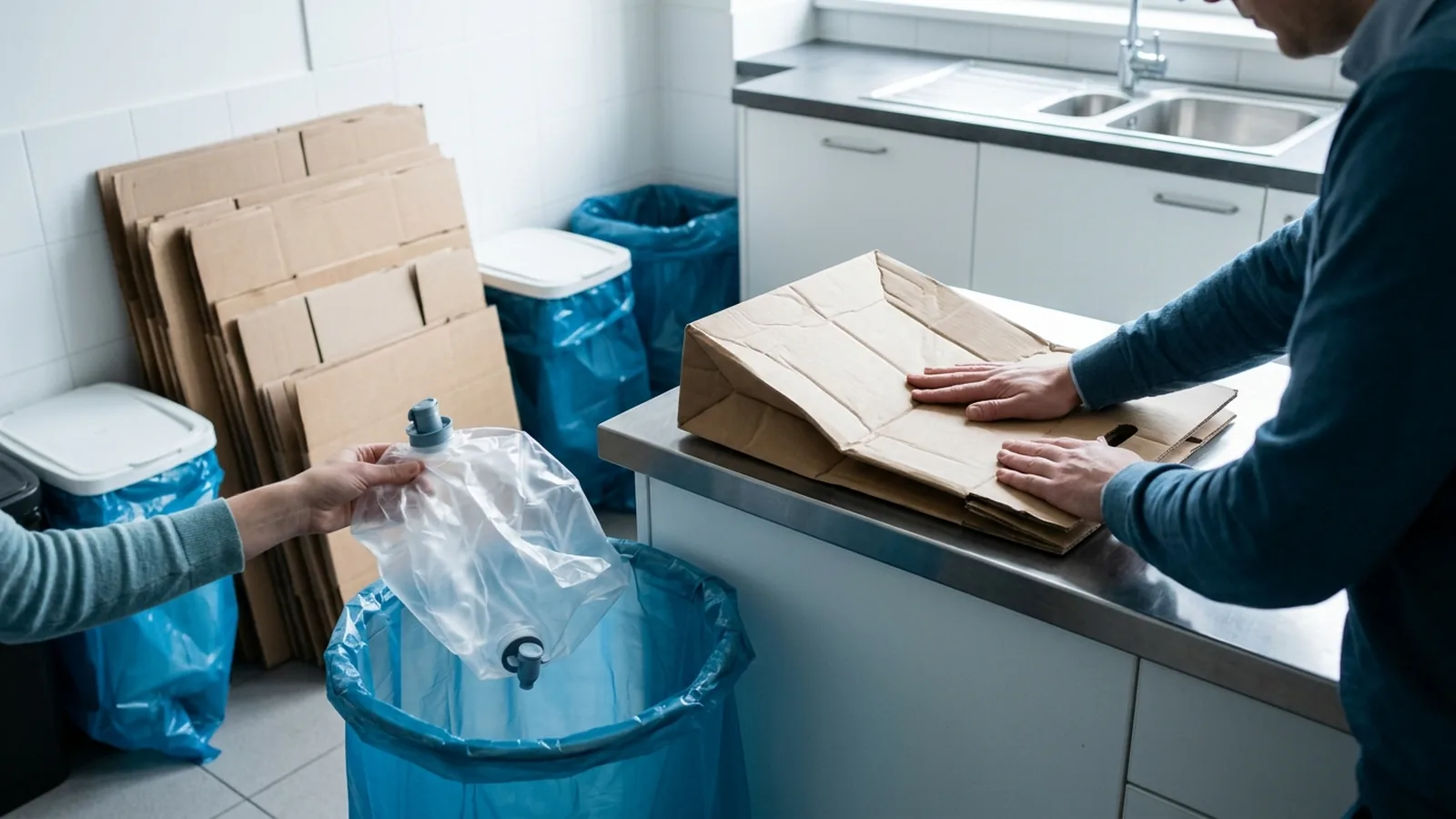
If you still want an order of magnitude, you can apply Spadel's 40% to the 259 grams from Ghent University: about 155 grams per litre. That exercise mixes two sources with a different base (the SPA Reine PET range against average bottled water in Flanders), and the SPA Fountain's electricity is not included. Treat it as an order of magnitude, not a measurement. It does not change the conclusion: the pack sits closer to the bottle than to the tap. How to sort the empty pack afterwards is explained in recycling a 10-litre water pack.
Five items that no figure includes
All the figures above leave something out. A fair comparison needs this list.
Not counted:
- the manufacturing of the unit itself and its transport to your office;
- the filters of a mains-fed cooler, which last about 5,500 litres according to PHIL;
- the technician who drives over for maintenance or a breakdown;
- the delivery of the packs: 126 litres a month is 126 kilos of water travelling to your office, in a distributor's van or in a colleague's boot;
- the carbon dioxide for sparkling water, for which no supplier publishes a footprint.
We found no supplier that sets a mains-fed cooler and a pack dispenser side by side over their whole life cycle, on the same base.
What does that mean for an office of eight people?
A difference of a few hundred kilos a year. For 1,512 litres a year, our calculation gives these totals, with the yearly cost added:
| Option | CO2 per year | Cost per year |
|---|---|---|
| Tap and carafe | 0.26 kilos | 8 to 14 euro of water |
| Mains-fed water cooler (standby included) | 9.5 to 11.2 kilos | 608 to 794 euro at PHIL, excluding VAT, contract of at least 60 months |
| SPA Fountain with packs | order of magnitude 235 kilos, without the unit's electricity | 2,029 to 2,262 euro, excluding VAT |
| PET bottles | 392 kilos | 887 euro |
The prices come from PHIL (50 to 65 euro rent a month, filters and maintenance included, deposit of 3 months), from spafountain.be (18.50 euro rent a month, excluding VAT) with the pack at 11.95 to 13.49 euro excluding VAT at Bruneau, a reference listed as out of stock on 31 October 2026, and from Test Aankoop for the 1.5-litre SPA Reine bottle (average market price 0.88 euro, undated).
Worth noting: per litre, the bottle is cheaper than the SPA Fountain with packs (rent included), while the pack has the smaller footprint. If you choose on both CO2 and price, you end up with the tap or a mains-fed cooler. If you want mineral water without plumbing, the pack costs more than a mains-fed cooler in euros and in CO2, and less CO2 than bottles. Mains-fed coolers are listed in the ranking of mains-fed water coolers.
Can a supplier still put a generic environmental claim on a quote?
No. The act of 22 July 2026, the Belgian transposition of Directive 2024/825, has applied since 27 September 2026, according to law firm Altius. Generic environmental claims are only allowed with recognised, demonstrable environmental performance. Claims of neutral or reduced emissions that rest on offsetting are never allowed.
For your quote, that means a percentage without a base deserves a question. Less than what, measured by whom, and per litre or per unit? Spadel gives a base, the SPA Reine PET range. We found no figure for a mains-fed cooler that uses the same base.
Tap, cooler, pack or bottle: the verdict per office
On CO2 alone, the tap wins by far. A mains-fed cooler comes close and serves chilled water, but at PHIL you sign for at least five years and you need a water connection. The SPA Fountain with packs is the option for offices that want no plumbing, no long contract and a fixed composition in the glass: you then pay 1.34 to 1.50 euro per litre, with 40% less CO2 than the average SPA Reine PET range according to Spadel. Still water only, and the packs are ordered and stored separately; where to buy them and what they cost is covered in ordering 10-litre SPA Reine packs. PET bottles are the most expensive option in CO2.
Sources
Consulted on 31 October 2026.
- Thomassen et al., The environmental impact of household's water use: A case study in Flanders, Science of the Total Environment 770 (2021) 145398. Original not opened (access refused); figures as quoted in the next two sources.
- Zúñiga et al., Assessing the Environmental Impacts of Household Water Supply, Sustainability 15(3) 1946 (2023), with the figures of Thomassen et al. (0.17 and 259 kg CO2-eq per m³, share of PET and transport): mdpi.com
- Aqualex, report on the environmental impact of water (Ghent University figures per litre, Circulo standby consumption, saving per employee): aqualex (pdf)
- BRITA, Top Compact, standby consumption (UK site): brita.co.uk
- Electricity Maps, Grid in review 2025, Belgium: electricitymaps.com
- SPA, packaging with CO2 and plastic reductions and their base: spa.be
- SPA Fountain, 10-litre pack page: spafountain.be
- SPA Fountain, compact product page (rent, VAT, temperature, energy class): spafountain.be
- Bruneau, 10-litre SPA Reine pack, reference 793-286: bruneau.be
- PHIL, drinking water systems (rent, term, deposit, filter, CO2 cylinders): phil.be
- CallMePower, price per m³ at De Watergroep, updated 20 May 2026: callmepower.be
- Test Aankoop, SPA Reine 1.5 litres, average market price: test-aankoop.be
- Altius, transposition of Directive 2024/825 by the act of 22 July 2026: altius.com
- VRT NWS, deposit not in the Flemish coalition agreement, 1 October 2024: vrt.be
- Flemish Parliament, debate on a deposit, 3 February 2025: vlaamsparlement.tv
- Radar (AVROTROS), bottled water versus tap water, 19 February 2021: radar.avrotros.nl
- Dunea, tap points and tap water, December 2021: dunea.nl (pdf)
- Our own calculations: consumption (8 people, 0.75 litres per working day, 21 working days), CO2 per year, electricity per litre, the pack exercise, cost per litre and per year, with the assumptions stated in the text.
Comparator
Compare water coolers side by side.
Compare now →
Frequently asked questions
The Beste Waterkoeler editorial team compares office water coolers and drinking water using public sources: product pages, price lists, technical sheets and official figures. The articles are written with AI and reviewed by the editorial team. Every price and figure is shown with its source and the date we read it. We do not test the machines ourselves.